Kaohsiung Medical University's Phase II, Stage 2 of the Higher Education Sprout Project aims to "Cultivate Foresight Talents in Smart Health and Sustainable Resilience." The strategy is focused on three key strategic pillars: Enhancing Campus Sustainable Resilience, Cultivating Key Capabilities in Smart Health, and Promoting Action for Sustainable Social Value. These efforts integrate four core elements: Human-centered Care, Cross-disciplinary Innovation, Smart Health, and Social Action. The achievements and highlights are summarized as follows:
A. Teaching Innovation and Enhancement
1. Universal integration of programming courses and joining the " Taiwan Artificial Intelligence College Alliance (TAICA)" to cultivate cross-disciplinary digital talents: We link information literacy assessments to guide students in taking Python (I) or (II), raising the course enrollment rate from 33% (Academic Year 2018) to 85.23% (Academic Year 2025, Semester 1). Starting Academic Year 2024, Semester 2, we joined TAICA, offering 14 AI-related courses and 4 AI-specialized credit programs. This provides students with the opportunity to take AI courses at top-tier universities across the alliance, resulting in 300 student enrollments over two semesters.
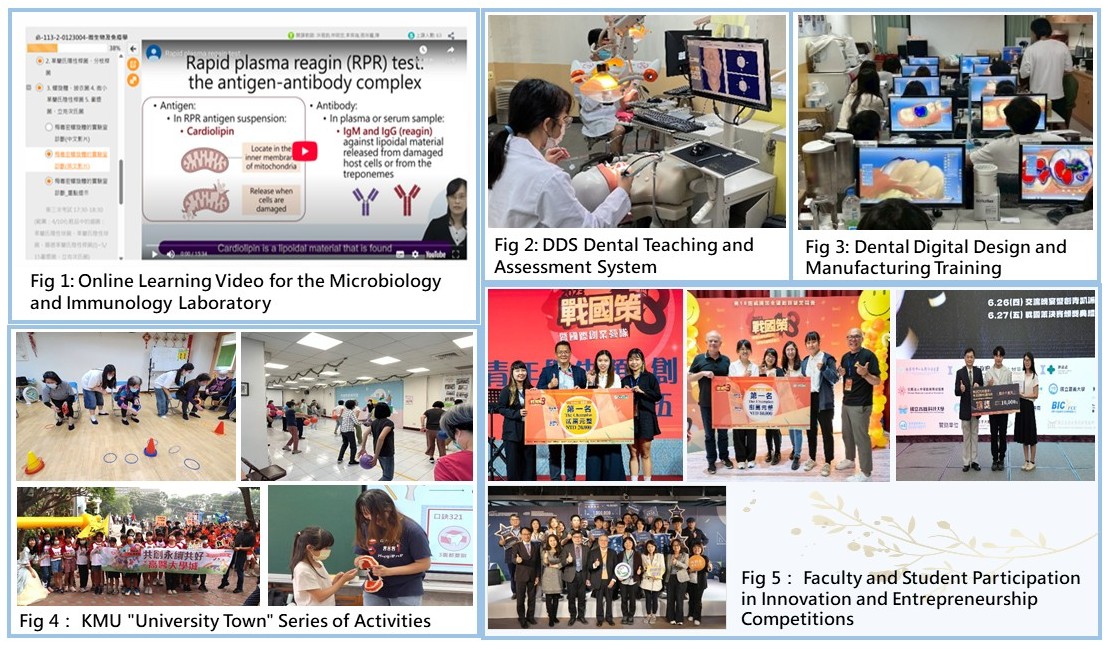
2. College Education emphasis on “Health Promotion and Professional Practice,” leveraging smart technologies to transform medical education: By integrating AR, VR, and AI technologies, we enhance hands-on learning in anatomy through the use of 3D Slicer with VR tools. Collaboration with the Department of Oral and Maxillofacial Surgery produced 3D models of cervical nerve variations, strengthening students’ professional competence and modeling skills. AI-assisted instruction further improves students’ diagnostic accuracy in identifying lymph node metastasis of oral squamous cell carcinoma from 50–75% to 100%.
3. Accumulating the highest number of approved Teaching Practice Research Projects (TPRP) among private medical universities, with 7 faculty members receiving national educational honors: Over the past seven years, 188 TPRP proposals were approved by the Ministry of Education, ranking first among private medical universities, with project execution experience across all colleges. In the last five years, this commitment has led to 7 faculty members receiving the highest educational honors, including three Distinguished Teacher Awards, one Hsing Yun Education Award, one Educator Role Model Award, and two School Sports Contribution Awards.
B. Reinforcing University Social Responsibility
1. Building a resilient campus with diverse societal impact to shape the “KMU University Town” for sustainable co-prosperity: Residential education is aligned with the SDGs, empowering students through a “learning-by-doing” model that deepens their understanding and application of sustainability issues. Centered on the vision of “Sustainable University Town Development,” we connect resources from campus and affiliated institutions to create an ecosystem of collaborative learning with the community. From 2023 to 2025, over a hundred activities were held, attracting nearly 4,400 participants with a satisfaction rate exceeding 98%. Through community engagement, health promotion, and local innovation, the project cultivates students' problem-solving abilities, strengthens the resilient connection between the locality and the university, and serves as a training base for the new generation of community service providers.
2.Establishing a new model for sustainability and advancing a 2050 net-zero campus: Aiming to create a “Net-Zero and Sustainable Campus,” KMU comprehensively promotes energy saving, carbon reduction, green transition, and sustainability education. We have established sustainable governance policies and signed the "University Sustainability Development Initiative," integrating green procurement, resource recycling, and smart energy-saving measures. In 2025, we continue to promote the carbon inventory system, completing ISO 14064-1 internal verifier training, with 29 individuals successfully certified.
-
Energy Reduction: Through the replacement of high-energy-consumption equipment and the implementation of smart HVAC management,electricity consumption was reduced by 1.82% in 2024 and is expected to reach 1.65% in 2025.
-
Water Management: Following the activation of smart water meters, water usage has decreased by 30% compared to 2023.
-
Waste Management: The resource recycling rate reached 19% in Academic Year 2024, and the "Trash Challenge" game developed by RE-THINK was utilized to deepen plastic reduction awareness.
-
Collaboration: KMU collaborates with the Kaohsiung City Government Net-Zero Academy to participate in local carbon management talent cultivation and constructs a co-learning sustainability ecosystem.
C. University-industry Cooperation and Bonding
1. Strengthening Career Competitiveness Through Internships, Achieving Outstanding Employment Alignment: Internships are arranged by 20 departments, with a total of 4,154 students participating from Academic Years 2022 to 2024. The one-year post-graduation survey (2022–2024) shows that the job-major alignment rate has increased from 77.1% to 85.0%, demonstrating the university’s ability to cultivate talent that meets the needs of industry trends and social development. Furthermore, results from the 2021–2023 Employer Satisfaction Survey show that satisfaction with graduate performance has been consistently maintained at 4.5 points or above (on a 5-point scale) over the last three years, earning high recognition from employers.
2. Advancing Academic Research and Industry-Academia Collaboration, Elevating Research and Innovation Capacity: R&D capacity is built through courses such as summer R&D technical training. In 2025, the approval rate for the National Science and Technology Council (NSTC) College Student Research Project reached 51%, a significant increase from 44% the previous year. In addition, KMU actively participates in the Taiwan International Medical and Healthcare Exhibition. In 2025, in response to the "Healthy Taiwan" national policy, we led 9 R&D teams and 3 KMU spin-off ventures to showcase healthcare solutions focusing on four major themes: Smart Healthcare, Home Healthcare and Caring, Innovative Surgical Implants, and Functional Health Supplements.
D. Promoting Publicity of Higher Education】
1. Implementing Comprehensive Academic and Support Services to Enhance the Multi-Competency Development of Economically or Culturally Disadvantaged Students: KMU provides comprehensive support to economically or culturally disadvantaged students, achieving a 100% support coverage rate. Through individualized academic tutoring, the national examination pass rate increased significantly from 70% in 2017 to 82.35% in 2024. To strengthen students’ multi-competency development and future competitiveness, we actively offer skill-building workshops and diverse learning programs, enabling students to enhance professional literacy and develop secondary areas of expertise. Since 2023, 23 students have obtained professional certifications, and 45 students have completed diverse training programs and received certificates of completion.
2. Outstanding Performance in THE University Impact Rankings, Achieving Remarkable Results Across Multiple SDG Indicators: In the 2025 Times Higher Education University Impact Rankings, KMU achieved an impressive overall placement—12th in Taiwan and 3rd among private universities—with recognition across all 17 Sustainable Development Goals. Moreover, KMU excelled particularly in SDG 3 (Good Health and Well-Being), ranking 8th globally and 2nd in Taiwan. KMU also made significant progress in SDG 5, SDG 10, SDG 14, SDG 15, and SDG 16, all ranking within the global 101–200 range. Among these, KMU achieved:
-
1st in Taiwan for SDG 5 (Gender Equality)
-
2nd in Taiwan for SDG 10 (Reduced Inequalities)
-
3rd in Taiwan for SDG 14 (Life Below Water)
The aforementioned key achievements demonstrate KMU's multiple innovative breakthroughs in educational quality, fulfillment of social responsibility, and research and innovation momentum. Moving forward, we will utilize these results as a vital foundation to continuously elevate our overall educational endeavors and maximize our social impact.